Step‑by‑step analysis of a 64‑bit Windows PE executable, focusing on entry point analysis, runtime initialization, stack frame inspection, and conditional branching to understand how user input is validated in a basic crackme challenge.
Windows PE Reverse Engineering – Crackme #2
Infos:
- Executable name: 3outof6.exe
- Format: PE32+
- Architecture: x86-64 Windows
- Sections: 19 sections
- Executable: Console
Techniques/Concepts used
- RIP-relative addressing to access data without an absolute address
- DLL imports & IAT (Import Address Table)
- Environment dependency awareness
- CRT / Runtime initialization analysis
CRT (C RunTime) all code automatically added by the compiler. RIP = address of the next instruction, used for relative addressing in x86‑64.
- Entry Point address:
0000000100401000
0000000100401000 <WinMainCRTStartup>:
   100401000:	48 83 ec 28          	sub    rsp,0x28
   100401004:	48 8d 0d 75 00 00 00 	lea    rcx,[rip+0x75]        # 100401080 <main>
   10040100b:	e8 20 01 00 00       	call   100401130 <cygwin_crt0>
   100401010:	45 31 c0             	xor    r8d,r8d
   100401013:	31 d2                	xor    edx,edx
   100401015:	31 c9                	xor    ecx,ecx
   100401017:	e8 34 01 00 00       	call   100401150 <cygwin_premain0>
   10040101c:	45 31 c0             	xor    r8d,r8d
   10040101f:	31 d2                	xor    edx,edx
   100401021:	31 c9                	xor    ecx,ecx
   100401023:	e8 38 01 00 00       	call   100401160 <cygwin_premain1>
   100401028:	45 31 c0             	xor    r8d,r8d
   10040102b:	31 d2                	xor    edx,edx
   10040102d:	31 c9                	xor    ecx,ecx
   10040102f:	e8 3c 01 00 00       	call   100401170 <cygwin_premain2>
   100401034:	45 31 c0             	xor    r8d,r8d
   100401037:	31 d2                	xor    edx,edx
   100401039:	31 c9                	xor    ecx,ecx
   10040103b:	48 83 c4 28          	add    rsp,0x28
   10040103f:	e9 3c 01 00 00       	jmp    100401180 <cygwin_premain3>
We can see that the program uses cygwin, which is a large DLL that emulates Unix (POSIX) behavior on Windows.
https://cygwin.com/
Here is a simple diagram:
Program
    ↓
libc Cygwin
    ↓
cygwin1.dll
    ↓
 Windows
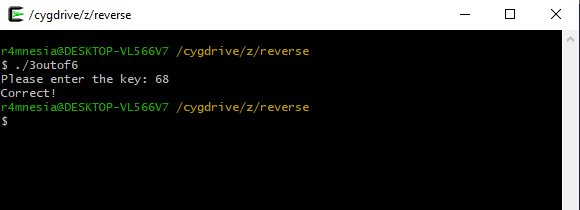
The first step is to have cygwin1.dll on the system. Since the binary is dynamically linked against Cygwin, it requires this DLL to run correctly. Once the DLL is accessible (via a Cygwin installation or by placing it in the PATH or the binary folder), the standard output is visible from any Windows terminal (cmd, PowerShell, or Cygwin terminal).
All calls to Cygwin are simply initialization, so we are not interested in them.

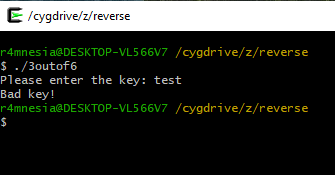
The part that will interest us in order to better understand is the following:
sub    rsp,0x28
lea    rcx,[rip+0x75]
The sub rsp,0x28 is for the shadow space, a Windows convention before each call.
0x20–> shadow space0x08–> stack alignment at 16 bytes Then we load the address ofrip + 0x75, which gives us10040100b + 0x75 = 100401080.
Let’s go to the address 100401080.
0000000100401080 <main>:
   100401080:	55                   	push   rbp
   100401081:	48 89 e5             	mov    rbp,rsp
   100401084:	48 83 ec 30          	sub    rsp,0x30
   100401088:	e8 73 00 00 00       	call   100401100 <__main>
   10040108d:	c7 45 fc 44 00 00 00 	mov    DWORD PTR [rbp-0x4],0x44
   100401094:	48 8d 05 65 1f 00 00 	lea    rax,[rip+0x1f65]        # 100403000 <.rdata>
   10040109b:	48 89 c1             	mov    rcx,rax
   10040109e:	e8 6d 00 00 00       	call   100401110 <printf>
   1004010a3:	48 8d 45 f8          	lea    rax,[rbp-0x8]
   1004010a7:	48 89 c2             	mov    rdx,rax
   1004010aa:	48 8d 05 66 1f 00 00 	lea    rax,[rip+0x1f66]        # 100403017 <.rdata+0x17>
   1004010b1:	48 89 c1             	mov    rcx,rax
   1004010b4:	e8 67 00 00 00       	call   100401120 <scanf>
   1004010b9:	8b 45 f8             	mov    eax,DWORD PTR [rbp-0x8]
   1004010bc:	39 45 fc             	cmp    DWORD PTR [rbp-0x4],eax
   1004010bf:	75 11                	jne    1004010d2 <main+0x52>
   1004010c1:	48 8d 05 52 1f 00 00 	lea    rax,[rip+0x1f52]        # 10040301a <.rdata+0x1a>
   1004010c8:	48 89 c1             	mov    rcx,rax
   1004010cb:	e8 40 00 00 00       	call   100401110 <printf>
   1004010d0:	eb 0f                	jmp    1004010e1 <main+0x61>
   1004010d2:	48 8d 05 4a 1f 00 00 	lea    rax,[rip+0x1f4a]        # 100403023 <.rdata+0x23>
   1004010d9:	48 89 c1             	mov    rcx,rax
   1004010dc:	e8 2f 00 00 00       	call   100401110 <printf>
   1004010e1:	b8 00 00 00 00       	mov    eax,0x0
   1004010e6:	48 83 c4 30          	add    rsp,0x30
   1004010ea:	5d                   	pop    rbp
   1004010eb:	c3                   	ret
   1004010ec:	90                   	nop
   1004010ed:	90                   	nop
   1004010ee:	90                   	nop
   1004010ef:	90                   	nop
We can see a call to <__main>, but this calls a function in cygwin1.dll, so we’re not interested in it. We can see this because if we go to address 100401100, we see a call to __imp___main, which contains __imp, so it’s a function imported from a DLL.
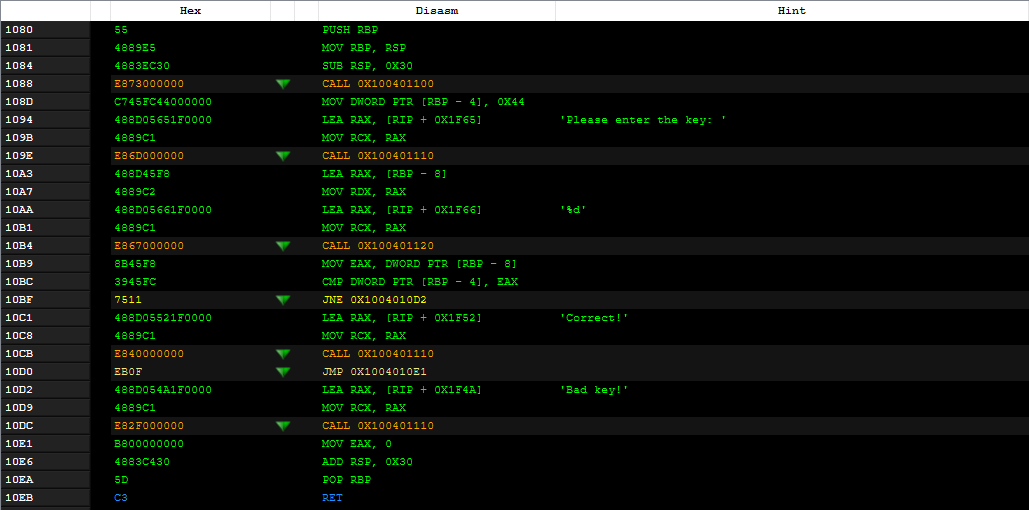
The key comparison is done with cmp DWORD PTR [rbp-0x4],eax at address 1004010bc. So DWORD PTR [rbp-0x8] is the user input because before the comparison it does mov eax,DWORD PTR [rbp-0x8] and then compares eax.
If it is not equal, it jumps to 1004010d2, which prints the message Bad key!. Thanks to the comparison, we can go back a little and see the value it puts in DWORD PTR [rbp-0x4] at address 10040108d. The value is 0x44, or 68 in decimal.